OPALCO's demand charge is a fee based on our peak rate of energy consumption in kilowatts (kW), rather than total energy used in kilowatt-hours (kWh). Demand charge is calculated by measuring the average power we draw in 15-minute intervals and billing us based on the highest single 15-minute peak during our billing cycle. This usually reflects some synchronous summation of load, for example, electric water heater heating, EV charger charging, etc. The demand charge recovers the cost to serve higher power with beefier infrastructure needed to serve that power. Electric rates are designed to recover the costs of the infrastructure and energy using a cost of service analysis.
Large commercial customers pay $4.62 per kW for demand up to 300 kW. The key differentiator between OPALCO Rate 010 (Small Commercial) and Rate 011 (Large Commercial) is the customer’s monthly peak electrical demand, measured in kilowatts (kW).
Kilowatts (kW) and Kilowatt-hours (kWh) can be compared to the speedometer and the odometer of a car:
Odd Fellows rate class changed from Small Commercial to Large Commercial in January 2026, since the metered demand was 21.4 kW. This happens when the demand exceeds 20kW and will maintain at this rate for 12 months after the most recent greater-than-20-kW instance.
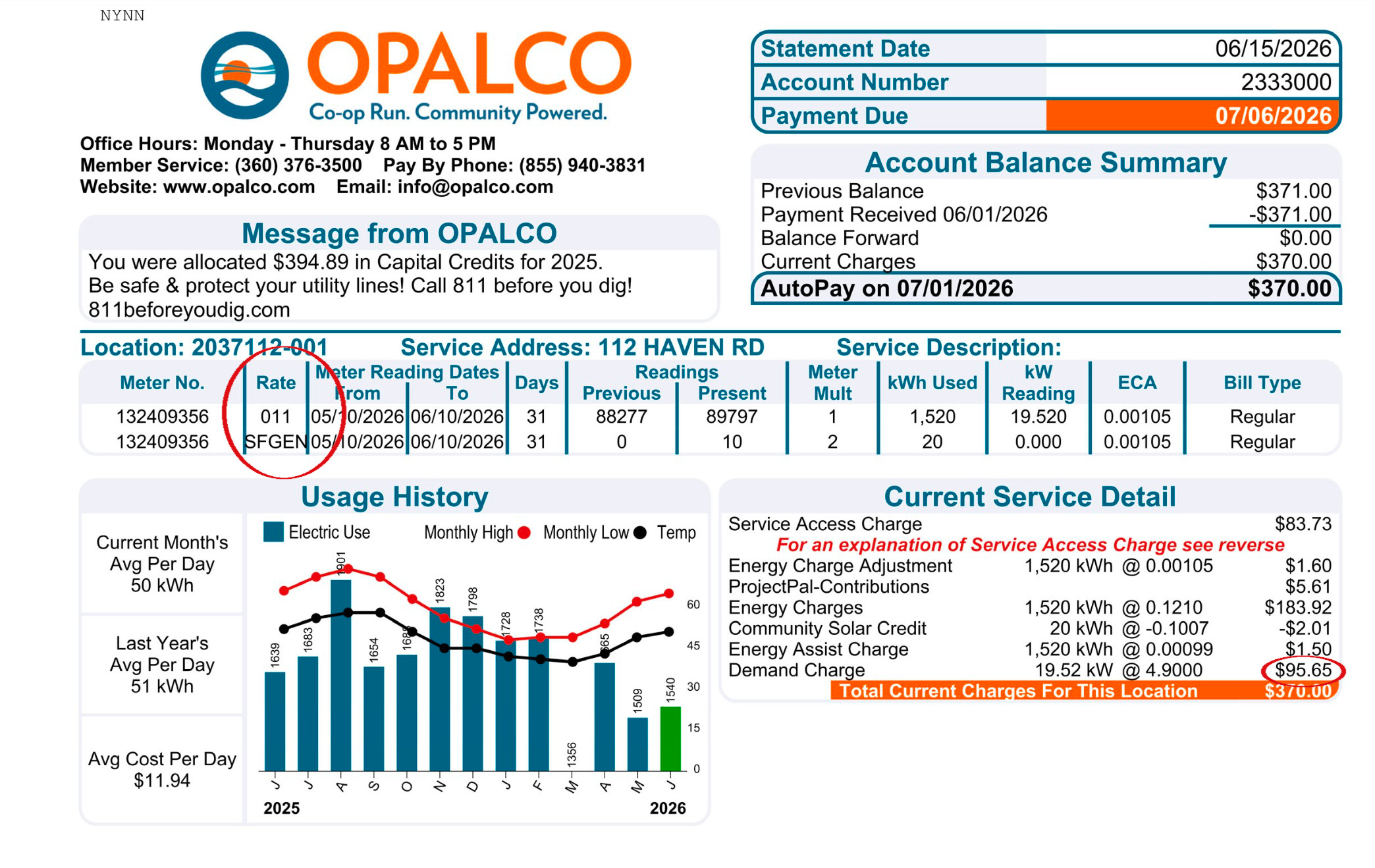
Small Commercial customers incur no demand charge. Once we go over the threshold and become Large Commercial, there may be demand charges. Recent Odd Fellows demand charges, when they have occurred, have often run around $95 a month. For example, in March, April, May and June of 2026, we paid a demand charge of $95.65 each month ($382.60 in four months). If this were to continue for a full year, it would cost us $1147.80.
Below is our bill from 6/15/2026. In the lower right (circled in red) is a demand charge of $95.65. Towards the upper left (also circled in red) is our rate classification of 011: Large Commercial.
It is possible to install electronics to automatically turn off high-consumption devices such as our heat pump, refrigerators and/or freezers. One question is how consistently we can avoid demand charges by doing this. It only takes one fifteen-minute peak during the month to trigger the demand charge for that month. If there are times of day, for instance, when we don't want to automatically turn off refrigerators or heat pumps, it might be difficult to reliably and consistently shut down the offending devices each and every time for the whole month. In addition, our renters can bring in their own equipment and kitchen appliances, with unprectable results for demand.
Rooftop solar alone (without a battery) can reduce or eliminate demand charges, due to "self-consumption" – energy that is used immediately in the building and is never seen by the electric meter. When the panels are producing energy, self-consumption tends to reduce all peaks, thus potentially reducing demand charges. It could even keep us out of the 011 (Large Commercial) rate classification, thus eliminating demand charges. However, solar panels alone are not a reliable means of reducing demand; anything that reduces their output, such as weather, time of day or time of year, will affect self-consumption – and such a reduction only has to happen once during the billing cycle – at the wrong time – to trigger the demand charge.
Battery storage is a much more reliable means of reducing demand charges, which is why the National Renewable Energy Laboratory notes that "high demand charges are often cited as a critical factor in battery project economics." In our case, assuming demand charges of $96.85 per billing cycle (which is what we've been experiencing so far in 2026), elimination of demand charges would pay for a $21,000 battery over a period of about 18 years. This corresponds well to the the battery's 15 to 20+ year lifetime.
In addition, the FranklinWH aPower 2 battery system which we are considering supports Time-of-Use (TOU) optimization. If we can determine the "danger" times when peaks are most likely to occur, the system's "aGate" controller can automatically charge the battery during "safe" times (when peaks are least likely to occur) and use that stored energy during "danger" times (when peaks are most likely to occur). Again, these savings could be quite significant over the battery's lifetime.
If we do want to consider the off-switch approach, we should investigate whether turning the appliances off during these "danger" times is practical. For example, does this work if we cannot reliably predict when a refrigerator might be in use for a wedding or food prep for a restaurant? Or would we risk turning the heat pump off during a cold snap, when it is drawing a lot of energy?
We also need to keep in mind that, for heat pumps and refrigerators, manufacturers typically warn against short on-off cycles, which often waste energy by forcing the system to consume high startup power, thus resulting in higher total energy consumption. Would the period immediately after turning the devices back on therefore be more likely to include peaks that trigger demand charges? In addition, the surges that can occur when the devices are turned on can trip circuit breakers, cause extra wear on the devices' compressors, and potentially damage the compressor and/or the compressor's starter relay. Many heat pump systems feature built-in delays to protect the hardware.